What is the
HSK exam?
HSK (汉语水平考试 — Hanyu Shuiping Kaoshi) is the official international standardized test of Mandarin Chinese proficiency, administered by Hanban under China's Ministry of Education. It is recognized by over 3,000 universities and employers worldwide.
International standard
HSK is administered in 120+ countries through 800+ test centers. It is the most widely accepted Mandarin proficiency credential globally.
Official recognition
HSK certificates are required for university admission, scholarship applications, and employment by Chinese government and multinational companies.
Six levels (HSK 1-6)
Each level builds on the previous, from absolute beginner (150 words) to near-native fluency (5,000+ words). Aligned with CEFR A1-C2.
Test format
The HSK exam has three sections. Higher levels include more sections and longer passages.
Listening (听力)
Multiple-choice questions based on dialogues, monologues, and short conversations played from audio recordings.
Reading (阅读)
Comprehension questions on sentences, short passages, and longer articles. Tests vocabulary, grammar, and reading speed.
Writing (书写) — HSK 3+
Word ordering, sentence completion, and essay writing. Required from HSK 3 onwards. HSK 5-6 includes structured composition.
The six HSK levels
A comparison of vocabulary, test length, and CEFR equivalents across all six HSK levels.
| Level | Vocab | Listening | Reading | Time | CEFR |
|---|---|---|---|---|---|
| HSK 1 | 150 words | 20 q | 20 q | 40 min | A1 |
| HSK 2 | 300 words | 35 q | 25 q | 55 min | A2 |
| HSK 3 | 600 words | 40 q | 30 q | 90 min | B1 |
| HSK 4 | 1,200 words | 45 q | 40 q | 105 min | B2 |
| HSK 5 | 2,500 words | 45 q | 45 q | 125 min | C1 |
| HSK 6 | 5,000+ words | 50 q | 50 q | 140 min | C2 |
Numbers reflect the standard HSK 3.0 syllabus. Writing sections apply from HSK 3 onwards.
Universities that accept HSK
Top universities worldwide recognize HSK as proof of Mandarin proficiency. Specific level requirements vary by program.
China
Peking University
Undergraduate · Graduate
Tsinghua University
Undergraduate · Graduate
Fudan University
Undergraduate · Graduate
Shanghai Jiao Tong University
Undergraduate · Graduate
Zhejiang University
Undergraduate · Graduate
Nanjing University
Undergraduate · Graduate
Tianjin University
Undergraduate · Engineering
Xiamen University
Undergraduate · Business
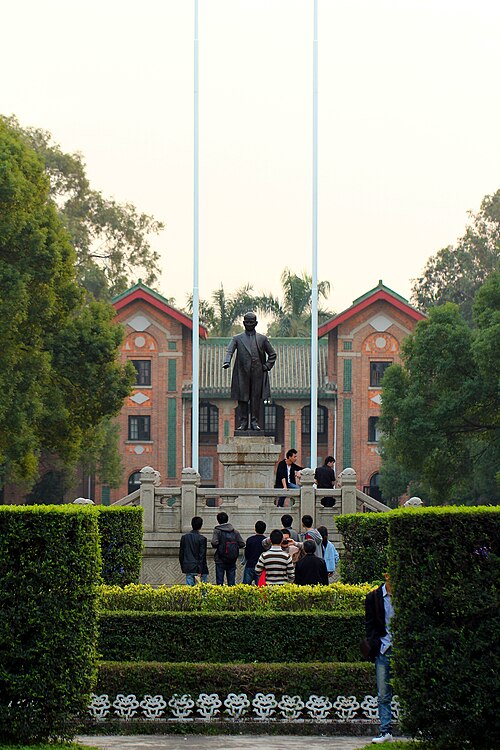
Sun Yat-sen University
Undergraduate · Graduate
Wuhan University
Undergraduate · Graduate
Singapore

National University of Singapore
Chinese Studies · Translation
Nanyang Technological University
Chinese Studies · Education
Singapore Management University
Business · Asian Studies
Hong Kong
The University of Hong Kong
Chinese Studies · Translation
Chinese University of Hong Kong
Chinese Language · Translation
Taiwan
National Taiwan University
Undergraduate · Graduate
National Tsing Hua University
Undergraduate · Graduate
USA
Harvard University
Chinese Studies · Linguistics
Stanford University
East Asian Studies
UK
University of Oxford
Chinese Studies
University of Cambridge
East Asian Studies
Australia
Australian National University
Asian Studies · Chinese
University of Melbourne
Asian Studies
Note: HSK level requirements are indicative based on publicly available program information. Specific requirements vary by faculty, program, and intake year. Always verify with the official admissions office of your target university. Logos are property of their respective institutions and used for identification only. MMC is not affiliated with or endorsed by any university listed.
About HSK 3.0 (the new standard)
HSK 3.0 is the updated standard rolled out by China's Ministry of Education starting 2021. It expands the vocabulary scope significantly (HSK 6 now requires 5,000+ words versus 2,500 in HSK 2.0) and aligns more closely with CEFR. MMC's curriculum follows the HSK 3.0 syllabus for all levels.
Ready to prepare for HSK?
MMC's structured HSK 1+2 Foundation Bundle is the fastest way to start. From there, our pathway takes you to HSK 6.